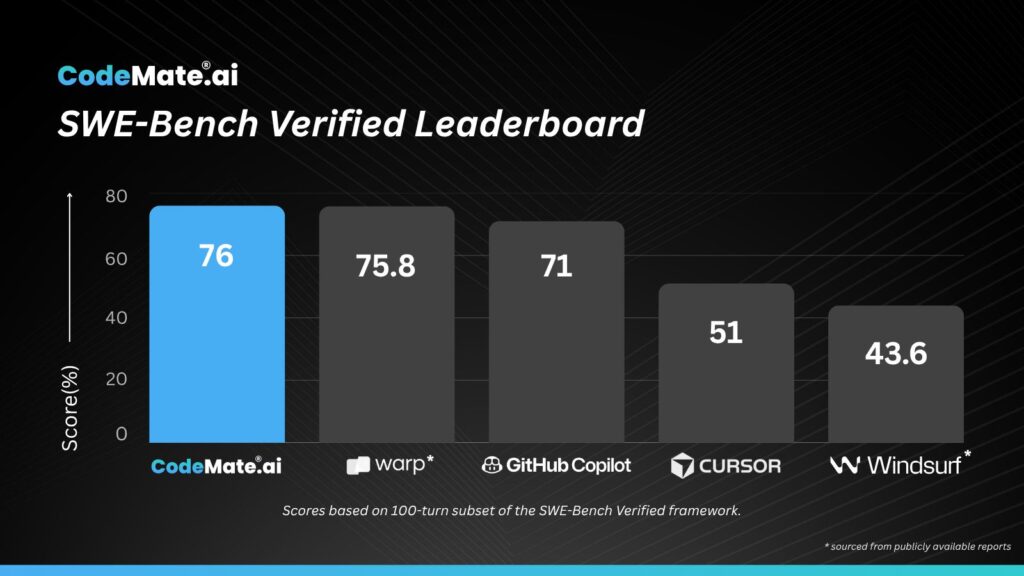
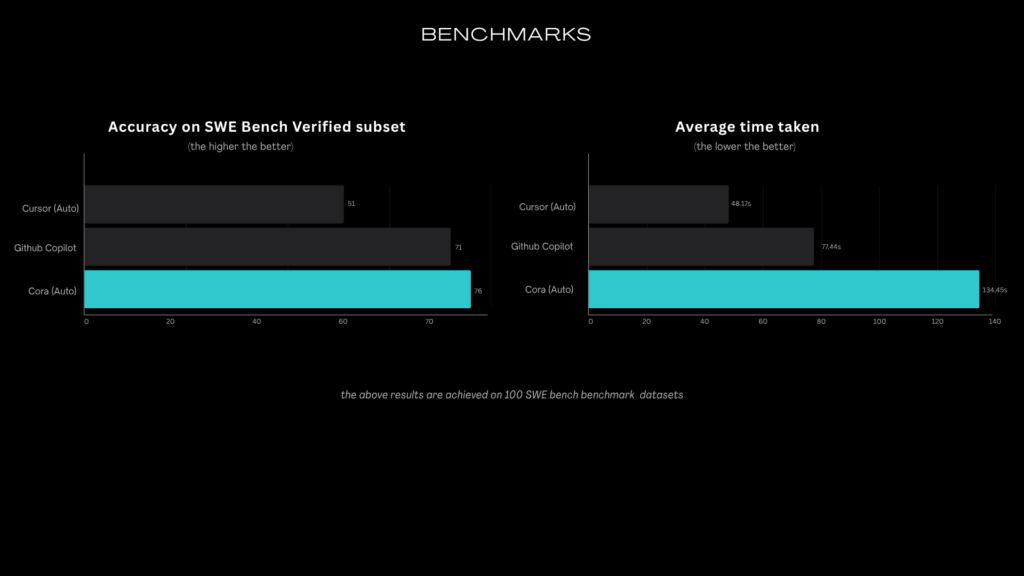
Cora by CodeMate AI has achieved a 76% resolution rate on the SWE-bench verified subset, outperforming industry leaders like GitHub Copilot and Cursor on real-world software engineering tasks.
This milestone reflects not just benchmark success, but a fundamental shift in how developers can collaborate with AI; from simple autocompletion to autonomous, context-aware code generation.
How Cora is Redefining Autonomous Code Generation
Cora is designed to handle complex software engineering workflows end-to-end. By utilizing a single-agent system that plans, edits, and governs the entire lifecycle of a coding task, it outperforms traditional autocomplete solutions.
What is Cora?
Cora is an autonomous coding agent for VS Code designed to handle complex software engineering workflows end-to-end. It doesn’t just suggest snippets - it plans, writes, tests, and validates production-ready code. Cora can:
- Generate complete projects from natural-language prompts - including files, dependencies, and configurations.
- Analyze entire codebases and make context-aware edits.
- Seek user approval before executing critical actions.
- Deliver validated, production-ready solutions directly in your workspace.
Unlike typical AI assistants, Cora understands architecture, dependencies, and intent - operating as a self-directed engineering agent rather than a reactive autocomplete tool.
How Cora Achieves State-of-the-Art Performance
Cora’s breakthrough lies in its combination of specialized reasoning tooling and a self-directed execution loop that continuously validates generated solutions. Instead of guessing, Cora models the problem, tests hypotheses, and refines code until it compiles and passes all checks.
Patch Generation and Tooling
Cora employs a single-agent architecture capable of autonomously generating and applying patches to large codebases. It is equipped with a specialized toolset for reasoning, code inspection, and system interaction - including file analysis, diff-based editing, command execution, and intelligent completion validation. We provide Cora with the following tools:
- inspect_workspace: Unified inspection layer for browsing, reading, and analyzing project structure or content before editing.
- modify_file: One editing surface that handles full rewrites, incremental diffs, insertions, or regex replacements.
- run_command: Execute shell and browser automation tasks under controlled approval.
- manage_task: Control Cora’s task lifecycle - start, switch, complete, or compress context intelligently.
- govern_workflow: Manages task understanding, clarification, and structured progress tracking.
The Agentic Advantage
Cora’s power lies in its autonomous agent architecture, designed for both independence and accountability. For your team Cora can:
- Reason across codebases to understand structure and dependencies.
- Make implementation decisions without constant developer input.
- Maintain consistency and code quality across multiple files.
- Debug and iterate until all tests pass.
- Request approval only for critical operations.
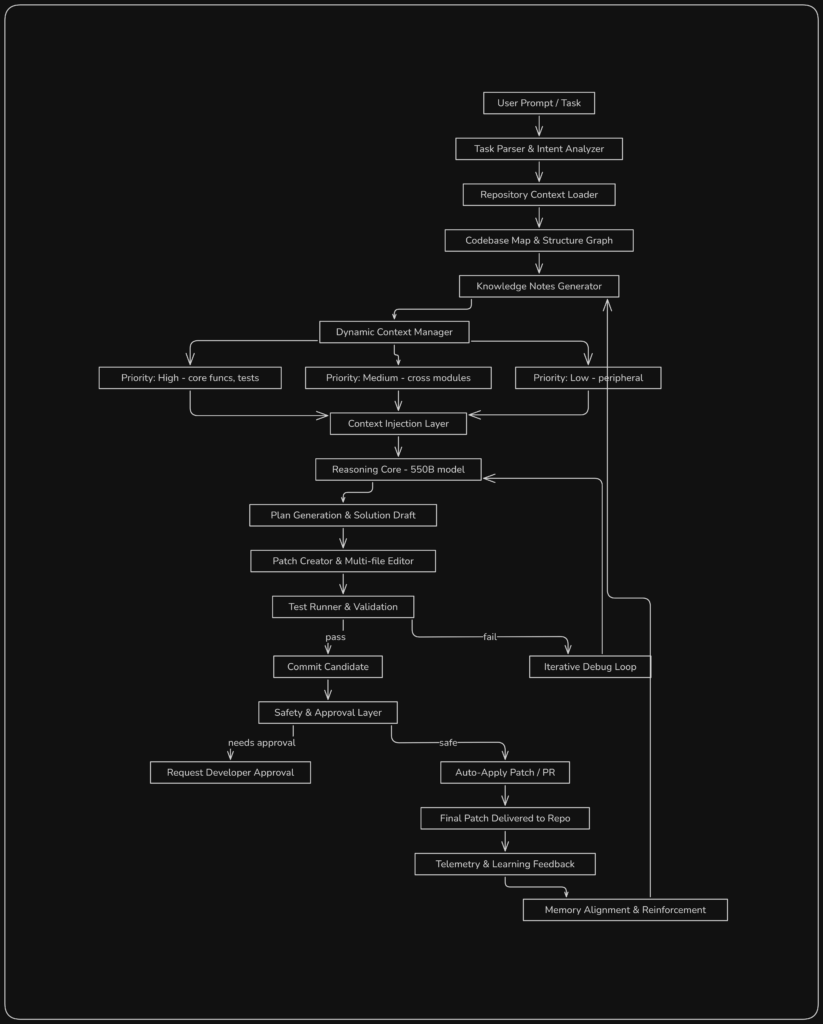
This flow chart shows how the internal architecture of CORA looks like.
Built for Real-World Engineering
The SWE-bench benchmark evaluates AI agents on real GitHub issues and pull requests from major open-source projects - representing the complexity of real-world software development. Each task requires:
- Understanding project architecture and conventions.
- Multi-file reasoning and consistency maintenance.
- Generating patches that pass existing test suites.
- Iterative debugging and refinement.
Cora successfully resolved 76 SWE-Bench verified instances, showing its ability to handle engineering challenges that typically require senior developer expertise.
Optimized for Correctness, Not Just Speed
In software engineering, speed without correctness adds rework - not value. Let’s compare how other tools fare:
- Cursor averaged 48 seconds per task but resolved only 51 out of 100 issues.
- Cora averaged 134 seconds per task yet resolved 76 issues with validated, working solutions.
The takeaway: correctness-first saves developers far more time downstream by avoiding debugging and manual fixes. In software development, the real metric is time to working solution, not time to first output.
Transparent, Reproducible, Open Evaluation
We believe transparency builds trust. Our SWE-bench results are fully reproducible and publicly available for verification. Our methodology includes:
- Standard SWE-bench dataset and test harness used across the research community.
- Consistent environment and timeout configurations.
- Open-source benchmark infrastructure maintained by leading institutions.
- Automated validation against real test suites.
All evaluation logs, configurations, and patch traces are available on our GitHub repository for independent review. This commitment to openness ensures developers can verify, reproduce, and trust every claim we make.
Experience Cora Yourself
Benchmarks prove performance - experience builds conviction. Get started:
- Install Cora from the VS Code Marketplace.
- Explore our evaluation results on GitHub.
- Visit codemate.ai to learn more.